
FREQUENTLY ASKED QUESTIONS
-
What happens if NOOSA® PLA is not discarded properly?NOOSA® PLA microfibers are biocompatible and non-persistent - unlike conventional synthetics, they do not accumulate in ecosystems or the human body. In its purest form, PLA is biodegradable under industrial conditions. While dyes and treatments applied during processing may not be, the base fiber itself does not carry the long-term environmental risk of petroleum-based synthetics. Of course, the ideal end-of-life pathway is always recycling through NOOCYCLE® - which is why we actively organize take-back with our partners.
-
What are the functional benefits of NOOSA® PLA compared to other biobased alternatives such as PBS and PHA?NOOSA® PLA offers skin-friendly pH, natural elongation, low flammability, anti-static properties, good breathability, and low odor retention. PBS focuses on softness and stretch recovery, while protein fibers such as PHA provide softness and reduced pilling. PLA is currently the most commercially mature, scalable, and recyclable biobased textile fiber available - and NOOSA® PLA is its highest-performance textile incarnation.
-
What collaborative strategies help advance adoption of biosynthetics like NOOSA® PLA?Capsule collections are a practical first step for brands wanting to test the material. Trust between innovators and brands, supply chain collaboration from designers to recyclers, and regulatory incentives are all key to scaling biosynthetic alternatives. NOOSA® works closely with partners at every stage to support this transition - from fiber to garment to recycled fiber again.
-
Can NOOSA® PLA be recycled?Yes. Through NOOCYCLE® - our patented chemical recycling technology - NOOSA® PLA can be fully depolymerized and turned back into virgin-quality PLA fiber. The process is selective, can separate PLA from other fibers or components, and produces output that is equivalent in performance to new fiber. This enables true circularity without downcycling or performance loss. NOOSA® PLA is the only textile fiber with this guarantee.
-
Can blended fabrics containing NOOSA® PLA be recycled?Yes. NOOCYCLE®'s selective dissolution process can process PLA-rich blends and separate NOOSA® PLA from other fiber components. While 100% NOOSA® PLA is the optimal scenario, blends are manageable and already being treated at pilot scale. A minimum 50% NOOSA® PLA content is required for recycling eligibility. Dedicated NOOSA® PLA recycling streams are growing as the take-back network expands.
-
What happens to the dyes and additives during NOOCYCLE® recycling?Dyes and additives fall out of solution during the solubilization stage and are then filtered and removed. The recovered PLA returns to production as clean, virgin-quality fiber - ready to be extruded and spun into new textiles.
-
How do you organize the recycling of end-of-life garments?The recycling of textiles containing NOOSA® PLA fiber is organized on a case-by-case basis, depending on the waste stream (post-industrial, pre-consumer or post-consumer). We ask our customers to bring back used textiles to our recycling facility. For B2B contexts such as uniforms and workwear, brands return garments directly to NOOSA®. For B2C, third-party logistics support collection depending on the brand's strategy. After recycling, customers receive a recycling certificate.
-
Have you worked with customers to collect end-of-life garments?Yes. Currently, post-industrial and pre-consumer textiles are recovered directly from partner mills. For post-consumer waste, the process is organized case by case with the brand. A concrete example is the R-SOCK circular sport sock with NOLT, replaced each rugby season (every four months). This take-back model is directly replicable for workwear and uniform programs - where garments are already centrally managed and replaced on schedule.
-
What is your vision for reverse logistics at end of product life?Post-industrial waste is recovered directly from partner mills. For B2B (uniforms, workwear), brands return used garments to NOOSA®'s recycling facility. Long-term, as NOOCYCLE® scales, recycled NOOSA® PLA fiber will progressively reduce the need for virgin biomass inputs - moving toward a system where the loop is truly closed.
-
What resources are available on traceability and recycling?NOOSA® provides feedstock traceability certifications (biobased, GMO-free, ISCC+), product certifications (Oekotex, ISO), and company-level B Corp certification. We can also provide a Life Cycle Assessment (LCA), recycling process efficiency studies, and property test reports on demand. After NOOCYCLE® processing, customers receive a recycling certificate confirming the recovery of their fiber.
-
What are the primary environmental advantages of NOOSA® PLA fiber?Unlike conventional petroleum-based fibers, NOOSA® PLA is made from renewable resources such as corn and sugarcane. It has a significantly lower carbon footprint than polyester, and - crucially - does not emit persistent microplastics. When combined with NOOCYCLE®, our patented recycling technology, it can be recycled repeatedly back into virgin-quality fiber without quality loss, supporting a genuinely circular lifecycle.
-
What is the carbon footprint of NOOSA® PLA fiber compared to polyester?NOOSA® PLA has a significantly lower carbon footprint than polyester. It is derived from renewable crops rather than fossil fuels, and does not emit persistent microplastics. Its end-of-life recyclability through NOOCYCLE® further reduces its overall environmental impact across multiple use cycles.
-
Is NOOSA® PLA biodegradable during normal use?No - and this is actually a feature, not a limitation. NOOSA® PLA only biodegrades under specific industrial composting conditions. During wear, washing, and storage, the fiber remains completely stable, maintaining strong mechanical and color performance throughout its useful life. Controlled end-of-life breakdown means NOOSA® PLA stays intact when it should, and can be recovered and recycled when it should not.
-
Does NOOSA® PLA biodegrade everywhere because it comes from plants?No. Being biobased does not mean biodegrading in nature. NOOSA® PLA only breaks down under industrial composting conditions - it remains stable in soil, water, and home environments. This is a strength: unlike fossil synthetics, it does not persist indefinitely in the environment, and unlike unstable biobased materials, it holds its integrity during use. When the garment's life ends, NOOCYCLE® - our patented recycling technology - recovers the fiber back into virgin-quality PLA. The preferred end of life for NOOSA® PLA is always recycling, not composting.
-
Does NOOSA® PLA release microplastics when washed?Studies confirm that NOOSA® PLA does not emit persistent microplastics - unlike petroleum-based fibers such as polyester, nylon, or acrylic, whose particles accumulate in ecosystems and the human body. Any fine particles that may be released from NOOSA® PLA during washing are not persistent: they are biocompatible and biodegrade over time without lasting environmental harm. This is one of NOOSA® PLA's most significant advantages for both environmental compliance and upcoming EU regulation.
-
Do you provide colored yarn?Our standard product is white, but we can offer colored yarn on demand with a minimum order quantity (MOQ). We can also provide a dyeing guide for partners who prefer to dye at their stage of the process.
-
Does NOOSA® PLA compete with the food industry?No. NOOSA® uses industrial starch streams that are not intended for human consumption. The edible protein fraction from the same crops continues to go to food and feed markets, entirely separately. To give you an idea, we use the same fraction that goes to bioethanol production. NOOSA® PLA production does not divert food resources. Additionally, NOOCYCLE® recycling progressively reduces the need for new agricultural inputs - further decoupling NOOSA® PLA from land use over time.
-
Does NOOSA® PLA comply with EU textile regulations?Yes. NOOSA® PLA supports compliance with EU legislation on textile circularity, including mandatory recycling and sorting requirements (2026), minimum biobased content requirements, and extended producer responsibility under the ESPR framework. NOOSA® PLA's non-persistence in the environment is directly relevant to incoming microplastics regulation - a key topic for EU public health policy. The European Commission has prioritized the use of biomass for high-value material applications such as textiles - ahead of energy uses - as long as fair agricultural practices are followed (Cascading Use of Biomass, European Commission, 2022).
-
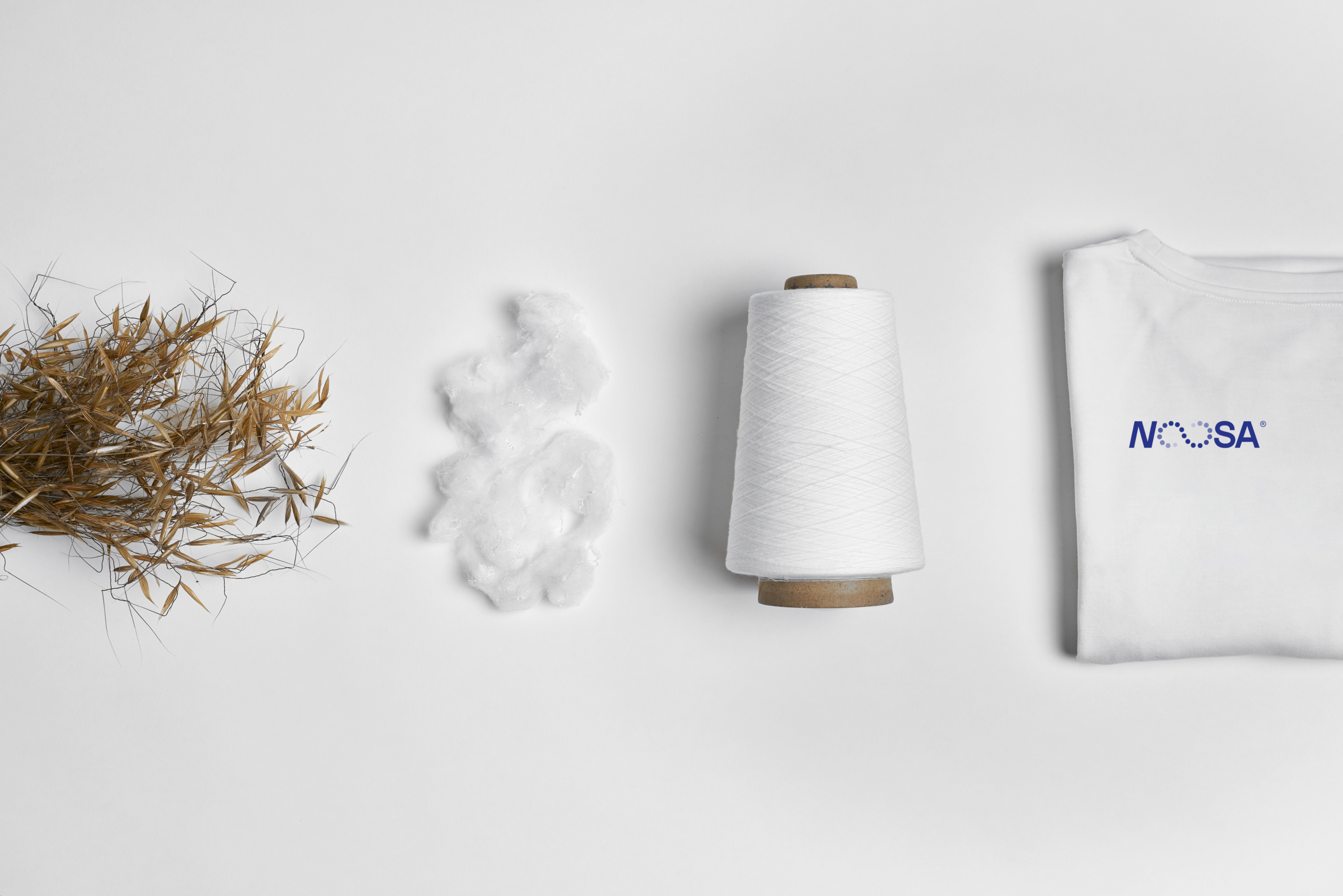
What is NOOSA® PLA?NOOSA® PLA is a high-performance, biobased textile fiber made from Polylactic Acid (PLA) - a polymer derived from renewable, GMO-free plant sources such as corn starch or sugarcane. Unlike conventional synthetic fibers derived from petroleum, PLA is produced through the fermentation of plant sugars into lactic acid, which is then polymerized into fiber. NOOSA® PLA goes significantly further than generic PLA: it is engineered for performance, with optimized durability, wash resistance, and full recyclability through NOOCYCLE® - our patented closed-loop recycling technology. Just as there are many grades and qualities of cotton on the market, not all PLA fibers are equal. NOOSA® PLA represents the high-performance end of that spectrum.
-
What is the composition of NOOSA® PLA?NOOSA® PLA is made from polylactic acid, sourced exclusively from GMO-free crops (corn, sugarcane, and wheat), not competing with the food industry.
-
What is the difference between PLA and NOOSA® PLA?Just as there are significant differences in quality between commodity cotton and premium long-staple cotton, not all PLA fibers perform the same. Generic PLA fibers exist on the market, but most of them are not optimized for textile applications, industrial washing conditions, or end-of-life recovery. NOOSA® has developed deep expertise in tailoring PLA specifically for textiles - in terms of fiber engineering, processing support, and circularity. The key differentiator is NOOCYCLE®, our patented recycling technology: NOOSA® PLA is the only textile fiber guaranteed to be 100% recycled back into virgin-quality fiber, endlessly. No performance loss. No downcycling. A true closed loop.
-
Is NOOSA® PLA a natural fiber or a synthetic fiber?NOOSA® PLA is a biobased synthetic fiber, also called biosynthetic. It originates from natural, renewable plant sources, but is processed and polymerized industrially to produce the final fiber. This distinguishes it from natural fibers like cotton or wool, while also setting it apart from conventional petroleum-based synthetics like polyester or nylon.
-
What does NOOSA® PLA feel like as a textile fiber?NOOSA® PLA has a smooth, soft hand feel comparable to conventional synthetic fibers or sometimes man-made fiber cellulosic. Depending on how it is processed and blended, it can range from lightweight and silky to more structured and resilient - making it adaptable to a wide range of applications, from apparel to technical workwear. Depending on blends and fabric construction, the touch and design can vary.
-
What are the characteristics of NOOSA® PLA in terms of elongation, tenacity, and shrinkage?We provide a full technical data sheet for each product on demand. Please contact us to receive the specifications relevant to your application. It shows a higher elongation than standard polyester, a lower tenacity than polyester but still higher than cotton.
-
Where does NOOSA® PLA fiber come from and what does the supply chain look like?Sugar from GMO-free crops is fermented into lactic acid, then polymerized into PLA. NOOSA® extrudes it into fiber, which is then spun into yarns and transformed into fabrics. We’ve started this project in China where we’re fully integrated and we’re now focusing on building the same ecosystem in Europe. By 2028, a 100% European supply chain is planned using French wheat as feedstock, further reducing transport emissions and dependency on overseas agriculture. You can find NOOSA® textiles in several textile hubs in the world to be integrated directly and smoothly into your supply chain.
-
Have you considered other generations of feedstock?1st generation feedstocks (corn, wheat, sugarcane) remain the most viable today. 2nd generation feedstocks (wood, straw) are too costly to process efficiently at scale, and 3rd generation (algae) is not yet commercially scalable. Long-term, NOOCYCLE® will significantly reduce our biomass dependency - as recycled NOOSA® PLA fiber re-entering the loop means less need for new agricultural inputs.
-
Are there certification or traceability measures to ensure GMO-free sourcing?Yes. NOOSA® holds GMO-free certifications to ensure full transparency and traceability in sourcing. We primarily use sugar from by-products of corn or sugarcane production, with plans to diversify feedstocks further. By 2028, we will be able to use sugar from French wheat. We can provide feedstock traceability certifications (biobased, GMO-free, ISCC+), product certifications (Oekotex, ISO), and company-level B Corp certification on request.
-
How do you label NOOSA® PLA?The majority of textile products must be labelled with fiber composition and percentages. Depending on the country, different regulations apply. As an example, NOOSA® is labelled '100% NOOSA® polylactide / polylactid' in Belgium, and '100% NOOSA® PLA' in the US. We can provide guidance on labelling requirements for your target markets.
-
How is NOOSA® PLA fiber processed?We provide dedicated technical support services, tailored to optimize results at every stage of the manufacturing process - from yarn spinning to dyeing to thermosetting. Our team works directly with textile partners to ensure consistent quality and performance throughout the production chain.
-
How does PLA compare to viscose / rayon?Viscose is derived from wood cellulose but requires intensive chemical processing, raising concerns around solvent use and forest sourcing. It is soft and breathable but has poor wet strength. PLA is more dimensionally stable, performs better in wash conditions, and its production does not involve the same chemical-intensive processes. PLA's end-of-life recyclability through NOOCYCLE® gives it a clear circular advantage, and it does not emit persistent microplastics - a growing concern for viscose as well.
-
Do NOOSA® PLA fabrics change after industrial washing?No. NOOSA® PLA products remain stable after multiple industrial washing and finishing cycles. They withstand tumble drying and tunnel finishing without deformation. Only white products may show slight yellowing after repeated tunnel finishing.
-
What is the best way to dry NOOSA® PLA products?Textiles made with NOOSA® PLA retain their tensile properties best when line dried after home laundering. Tumble drying is not recommended for 100% NOOSA® PLA products. For blended products, tumble drying at low temperatures is possible.
-
Can I iron NOOSA® PLA products?For 100% NOOSA® PLA products, ironing is not recommended - though it is rarely necessary, as PLA has excellent anti-crease properties. For products blended with NOOSA® PLA, ironing is possible and should be performed at low temperatures (under 100°C).
-
What detergent should I use to wash NOOSA® PLA products?We recommend mild detergents. Bleach is not recommended, as it may damage the fiber.
-
Which industries can benefit most from NOOSA® PLA?Hospitality, food service, healthcare, retail, and facility services are among the sectors where NOOSA® PLA makes the strongest case. These industries share structured procurement cycles, centralized laundry operations, and growing pressure to demonstrate environmental responsibility to guests, clients, and regulators. Workwear is where NOOSA® PLA finds its most natural home - performance requirements are high, and replacement cycles already provide the infrastructure for NOOCYCLE® closed-loop fiber recovery. NOOSA® PLA is an amazing solution to create petrol-free sportswear.
-
How can I integrate NOOSA® PLA into my uniform or product program?We work directly with brands, uniform studios, and hospitality groups to integrate NOOSA® PLA into custom garment programs. Whether you are starting from scratch or transitioning an existing range, we guide you through material selection, technical requirements, and end-of-life recovery planning - from first fiber to first recycling certificate.
-
Do you offer take-back or recycling programs for end-of-life garments?Yes. Closed-loop recovery is central to what we do. We work with partners to establish take-back pathways for garments made with NOOSA® PLA, ensuring that the fiber is recovered through NOOCYCLE® and returned to production rather than going to landfill. Get in touch to discuss what this could look like for your organization.
-
I have more questions - who can I contact?We are happy to go deeper on any topic. Reach out to us with your request and we will get back to you promptly.
-
How does PLA compare to cotton in terms of performance?NOOSA® PLA offers superior moisture-wicking and faster drying compared to cotton. It has natural bacteriostatic properties that cotton lacks, while offering comparable softness and breathability. NOOSA® PLA also requires significantly less water in production than cotton - one of the most water-intensive crops in the world. Where cotton biodegrades naturally, NOOSA® PLA's preferred end of life is recycling through NOOCYCLE® - which returns the fiber to virgin quality, something cotton cannot offer.
-
How does PLA compare to polyester?PLA has a significantly lower carbon footprint than polyester, as it is derived from renewable plant sources rather than fossil fuels. Critically, PLA does not emit persistent microplastics - unlike polyester, which sheds particles that accumulate in ecosystems and the human body. Polyester is more heat-resistant and has mature mechanical recycling infrastructure, but recycled polyester degrades in quality over cycles. NOOSA® PLA, through NOOCYCLE®, returns to virgin-quality fiber with every cycle. Additonnally, a lot of our customers replace polyester in their sportswear products because NOOSA® PLA is more comfortable on the skin as it is hypoallergenic.
-
How does PLA compare to wool?Wool is a natural, renewable, and biodegradable fiber with excellent thermal insulation and moisture regulation. PLA shares wool's low bacterial growth characteristics and offers better wash stability - wool is prone to shrinking and felting with improper care, while PLA is dimensionally more stable. PLA is also more consistent in quality and generally more affordable, as it is a manufactured fiber. Wool carries a higher carbon footprint per kilogram due to livestock farming, while PLA's environmental footprint is lower and continues to improve as feedstocks and recycling scale up.
-
How does PLA compare to nylon (polyamide)?Nylon is petroleum-derived and carries a high carbon footprint and persistent microplastic emissions. It is highly durable, elastic, and abrasion-resistant - making it popular in activewear and hosiery. PLA offers a more sustainable production profile and does not release persistent microplastics. PLA is less elastic than nylon but can be engineered for good stretch recovery when blended appropriately. For applications where circularity and environmental impact are priorities, PLA is a compelling alternative.
-
How does PLA compare to linen (flax)?Linen is one of the most environmentally low-impact natural fibers, requiring minimal water and pesticides. It is naturally biodegradable, strong, and breathable, but tends to wrinkle easily and can feel rough against the skin. PLA matches linen's breathability and surpasses it in softness and anti-crease performance.
-
Can NOOSA® PLA fabrics be washed normally?Yes. NOOSA® PLA fabrics can be washed at home up to 60°C, although lower temperatures are recommended to reduce energy use. NOOSA® PLA products also pass industrial washing tests (ISO 15797), remaining stable across repeated professional laundering cycles.
-
How does PLA compare to silk?Silk is a luxurious natural protein fiber known for its sheen, softness, and temperature regulation. It is biodegradable but requires delicate care and is not suitable for industrial washing. PLA can replicate some of silk's smooth, lustrous qualities in multifilament form, while offering far greater wash stability and lower cost. Silk production is associated with significant water and energy use; PLA's biobased production has a lower and more consistent environmental footprint.
-
How does PLA compare to acrylic?Acrylic is petroleum-derived and one of the worst offenders for persistent microplastic pollution - shedding significant quantities with every wash, accumulating in marine ecosystems and the food chain. PLA is biobased and does not emit persistent microplastics. It can be fully recycled through NOOCYCLE®, while acrylic has no meaningful end-of-life pathway. From an environmental standpoint, PLA is a substantially better choice in virtually every dimension.
-
Are NOOSA® PLA fabrics durable?Yes. NOOSA® PLA is stable during wear, washing, and storage, and is designed to last as long as conventional fibers. It does not biodegrade under normal conditions of use. NOOSA® PLA textiles maintain strong mechanical stability, UV resistance, and colorfastness throughout their useful life - and outperform many generic PLA fibers on the market precisely because NOOSA® PLA has been engineered for textile performance.
-
Why is NOOSA® PLA particularly well-suited to workwear and uniforms?NOOSA® PLA brings together the two things workwear demands most: performance and a credible sustainability story. It offers excellent tensile strength, shape retention, UV resistance, and natural bacteriostatic properties - all critical in professional environments. It passes industrial washing tests (ISO 15797), withstanding repeated cycles without deformation. Beyond performance, workwear also has structural advantages for circularity: uniforms are tracked, replaced on schedule, and often centrally collected - creating the ideal conditions for NOOCYCLE® closed-loop recovery. With NOOSA® PLA, when a uniform reaches the end of its life, the fiber does not.
-
Is NOOSA® PLA suitable for industrial washing?Yes. NOOSA® PLA products pass ISO 15797 industrial washing tests. They remain stable after multiple cycles, including tumble drying and tunnel finishing. Only white products may show slight yellowing after repeated tunnel finishing - a consideration to factor in for white uniform programs.
-
How does NOOSA® PLA address heat resistance and dyeing challenges associated with PLA?Standard PLA has a melting point of approximately 170°C and a glass transition temperature of approximately 85°C, which require adapted processes. These are well-understood properties, and NOOSA® provides optimized guidelines at every stage - from processing and dyeing to finishing - to ensure consistent results, including dark shades, using disperse dyeing with adjusted parameters. Home washing up to 60°C is safe. Ironing is not recommended for 100% NOOSA® PLA products but is possible for blends at temperatures below 100°C. NOOSA® is improving the properties of PLA fiber that exist in different product categories.
-
Is NOOSA® PLA only a replacement for polyester?Yes and no, it depends of the application. NOOSA® PLA is an excellent polyester alternative but also competes with natural and cellulosic fibers. It offers comfort, breathability, thermal insulation, natural bacteriostatic properties, and low odor retention. Its versatility makes it suitable for fashion, home textiles, activewear, and technical applications. Make sure to contact us if you have questions regarding a specific application.
-
What are the main uses of NOOSA® PLA fiber?NOOSA® PLA is used across a broad range of textile applications - from apparel and activewear (valued for its softness, breathability, rapid moisture transport, and bacteriostatic properties) to home textiles and professional workwear. Workwear and hospitality uniforms are a particularly natural fit, given existing replacement cycles and the potential for closed-loop NOOCYCLE® collection. It is also suited to eco-friendly packaging and non-woven fabrics.
-
Can NOOSA® PLA be blended with other fibers?Yes - and blending is one of NOOSA® PLA's key strengths. NOOSA® PLA blends well with cotton (adding softness and breathability), recycled polyester (boosting durability), and other natural fibers. Blending allows the final garment to be tuned for specific performance requirements without compromising on sustainability credentials. For end-of-life recyclability through NOOCYCLE®, a minimum NOOSA® PLA content of 50% is required - something we factor into blend recommendations from the start.
-
Is NOOSA® PLA dyeable?Yes. NOOSA® PLA can be dyed with disperse dyes, producing vibrant colors and strong lightfastness. Dark tones are achievable, and dope-dyed yarns give the highest fastness. Low-temperature, low-pH dyeing protects the fiber and ensures uniform results. Post-treatments can further improve fastness. NOOSA® provides guidelines for dyeing to its customers to ensure the most optimal results.
-
Can NOOSA® PLA achieve deep or vibrant colors?Yes. NOOSA® PLA can reach vibrant shades with dope-dyed fibers and yarns, which offer the best color fastness. With disperse dyes, dark colors are achievable in most cases by following our optimized dyeing recipes. These ensure uniform and durable results, making NOOSA® PLA suitable for both workwear and fashion applications.
-
Is NOOSA® PLA suitable for dark colors and fashion applications?Yes. NOOSA® PLA can achieve vibrant and deep colors with disperse dyes. For very dark shades, dope-dyed yarns offer the best color fastness. Conventional dyeing also performs well with optimized low-temperature recipes, making NOOSA® PLA suitable for a wide range of fashion aesthetics and workwear identity programs.
-
Can NOOSA® PLA fabrics be printed?Yes. NOOSA® PLA works well with digital, screen, and transfer printing. Pigment and UV-curable inks create bright, durable prints without requiring high heat. Sublimation printing is not suitable, as it requires temperatures above PLA's thermal limits. Heat sensitivity is easily managed with low-temperature curing.