Around 120 million tons of textile waste is generated worldwide each year. Less than 1% of it becomes new textile fiber, and more than 80% is landfilled or incinerated.
This article looks at where mechanical and chemical recycling stand today, with a focus on recycled polyester, the most produced recycled textile material today, and at how NOOCYCLE®, NOOSA®’s patented chemical recycling process for PLA textiles, approaches the problem differently.
Recycled polyester is not what most people think it is
Polyesters are the backbone of the textile industry. According to Textile Exchange (2026):
- 69% of the record 139 million tons of fiber produced in 2025 was synthetic.
- Polyester alone represents 82.5 million tons, 59% of all fibers.
- Recycled polyester totaled approximately 9.7 million tons, equivalent to about 12% of polyester production.
- 97% of that comes from PET bottles, not clothing.
Bottle-to-fiber is a change of feedstock, not a loop. And, it does not remove polyester’s negative externalities: recycled polyester is still a fossil-based plastic that sheds microplastics with every wash, just like virgin polyester.
Why is a garment so hard to recycle
A PET bottle is a single, clean polymer. A garment is dyed, printed, finished, often blended with elastane and sewn with polyester thread, even when it is labelled “100% cotton”. A key challenge is separation: isolating one usable material from a mixed product. Industrial processes struggle to do this on a large scale today.
Mechanical recycling: what exists at scale, and its limits
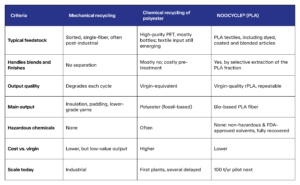
Mechanical recycling shreds textiles back into fibers, while thermo-mechanical recycling re-melts clean polyester into new filament. Both are simple and low-energy, but share three important limits:
- Quality loss: Each cycle shortens fibers and polymer chains.
- Purity requirements: Neither can separate blends; dyes, finishes, and elastane cannot be removed.
- Downcycling: Most output becomes insulation or wiping cloths; only around 2% of post-consumer textiles go to fiber-to-fiber recycling.
Chemical recycling of polyester: promising, but built for bottles
Chemical recycling breaks polyester down into its building blocks and rebuilds it at virgin quality. But many routes were designed for clean PET bottle flakes, or needs homogeneous, polyester-rich feedstock, which does not reflect most textile waste.
Most chemical routes cannot process complex blends, many rely on hazardous solvents or reagents, and the recycled output costs much more than the virgin material it replaces. Cellulose-based routes face the same issue: turning cotton waste into viscose-type fibers relies on toxic carbon disulfide. With capital-intensive plants and delayed projects, chemical recycling is not yet an industrial answer for used garments.
How NOOSA®’s NOOCYCLE® works
NOOCYCLE® is NOOSA®’s patented chemical recycling process dedicated to PLA textiles, protected by three patents, and a world first: the first closed-loop chemical recycling process of its kind. Rather than demanding clean, pure feedstock, it is designed around the reality of what textile waste looks like, blends included.
- Pre-treatment: Textile waste is washed and mechanically prepared.
- Selective extraction: A proprietary solvent dissolves only the PLA fraction, separating it from everything else in the textile: dyes, pigments, coatings applied on or inside the fiber, and other fibers such as elastane.
- Purification and depolymerization: The recovered PLA is purified and depolymerized into a lactic acid solution, under conditions optimized to preserve its optical purity.
- Repolymerization: The lactic acid is repolymerized into virgin-quality recycled PLA chips, ready to be spun into new textile fiber.
Thanks to this selective separation, NOOCYCLE® recycles 100% of the PLA in the textile back to virgin quality. The process relies on green chemistry: the solvents are bio-based, non-hazardous, and fully recovered within the loop. And because the PLA is rebuilt from its monomer, there is no loss of properties from one cycle to the next. The fiber can be recycled endlessly. And most importantly, NOOCYCLE® does all this at a lower cost than virgin material.
How the recycling routes compare
From the lab to industrial scale
After validating NOOCYCLE® at lab scale on real textile waste, NOOSA® is now scaling the process up to a 100 ton-per-year pilot line in Belgium. The pilot will process real post-industrial and post-consumer waste streams and lay the groundwork for an industrial recycling plant.
Why this matters now
Separate collection of textiles has been mandatory across the EU since January 2025. The revised Waste Framework Directive, in force since October 2025, makes extended producer responsibility for textiles mandatory, with fees eco-modulated on eco-design criteria such as recyclability. Collection is growing; what is missing is a downstream process that can accept what collection produces.
Brands will soon need to declare, not just claim, that their fiber can return to fiber. A material with a qualified textile-to-textile recycling route is what makes that declaration defensible.
Work with us
NOOSA® partners with brands and manufacturers preparing recyclable collections, in sportswear, workwear and apparel. Talk to our team about a partnership, or explore NOOCYCLE® and the NOOSA® PLA range.
Key takeaways
- About 120 million tons of textiles are discarded each year worldwide; less than 1% becomes new textile fiber.
- 97% of recycled polyester comes from PET bottles, not garments. Bottle-to-fiber is a change of feedstock, not a loop, and recycled polyester still sheds microplastics.
- Mechanical and thermo-mechanical recycling exist at scale but cannot separate blends, shorten fibers and end mostly in lower-value products.
- Chemical recycling of polyester was built for high-purity bottle feedstock: most routes can’t process blends, many rely on hazardous chemicals, and the output costs more than virgin material.
- NOOCYCLE® selectively extracts PLA from dyed, coated and blended textiles and rebuilds it into virgin-quality fiber, endlessly, using non-hazardous, fully recovered solvents, at a lower cost than virgin material.
- After lab-scale validation on real textile waste, NOOSA® is scaling NOOCYCLE® to a 100 t/yr pilot line.